Home >> Resources >> Technical Articles
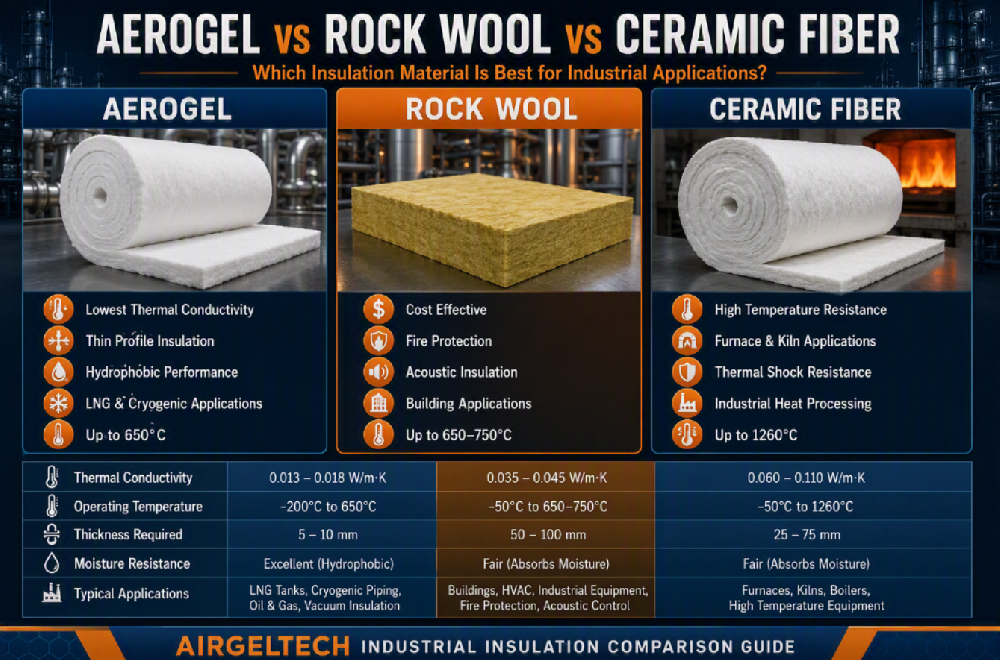
Selecting the right insulation material directly affects energy efficiency, operating costs, equipment performance, and project lifecycle economics. Among the most commonly used industrial insulation materials, Aerogel, Rock Wool, and Ceramic Fiber are frequently compared because each excels under different operating conditions.
This guide helps engineers, contractors, distributors, and industrial buyers quickly identify the most suitable material for their application.
*Actual service temperature depends on the specific product grade and manufacturer specifications.
Data references: ASTM C1728 (aerogel), EN 14303 (rock wool), ASTM C892 (ceramic fiber). Actual values vary by product grade and manufacturer.
Industrial insulation is not simply about reducing heat loss. The correct insulation solution must balance:
Selecting the wrong material can result in:
Higher energy bills
Excessive insulation thickness
Moisture-related performance degradation
Increased maintenance costs
Reduced equipment efficiency
Premature insulation failure
Aerogel insulation is one of the most advanced thermal insulation materials available today. Its nanoporous structure dramatically reduces heat transfer, allowing excellent thermal performance with significantly less thickness than conventional insulation materials.
Ultra-low thermal conductivity
Space-saving insulation design
Hydrophobic performance
Lightweight construction
Long service life
Reduced energy consumption
Industrial piping
LNG terminals
Petrochemical facilities
Offshore platforms
Cryogenic systems
Energy retrofit projects
Higher initial investment
Requires protective jacketing in exposed applications
Continuous service temperature typically limited to about 650°C
Rock Wool remains one of the most widely used insulation materials worldwide because it provides an excellent balance between cost, fire protection, and acoustic performance.
Cost-effective
Excellent fire resistance
Strong sound absorption
Easy installation
Widely available globally
Exterior wall systems
Roof insulation
HVAC ductwork
Fire-rated partitions
Commercial buildings
Industrial buildings
Requires greater thickness than aerogel
Performance can decline if moisture protection is inadequate
Less suitable for space-constrained projects
Ceramic Fiber insulation is specifically designed for high-temperature industrial environments where conventional insulation materials cannot operate reliably.
High-temperature resistance
Low thermal mass
Rapid heat-up and cool-down
Thermal shock resistance
Easy fabrication
Industrial furnaces
Kilns
Boilers
Heat-treatment equipment
High-temperature process systems
IARC Group 2B / EU Carcinogen Category 1B (H350i: May cause cancer by inhalation)
Mandatory dust control and respiratory protection during handling
High-temperature exposure may cause shrinkage over time
Typically more expensive than rock wool
Winner: Aerogel (≤650°C)
For industrial piping operating below approximately 650°C, aerogel often provides the best balance of:
Thermal efficiency
Reduced heat loss
Installation flexibility
Space savings
Compared with traditional insulation systems, aerogel can significantly reduce insulation thickness while maintaining comparable thermal performance.
Typical Industries
For piping operating between 650°C and 1000°C, ceramic fiber is generally the only suitable option among the three materials.
Winner: Ceramic Fiber
When operating temperatures exceed 1000°C, ceramic fiber becomes the preferred insulation solution.
Typical Industries
Its combination of high-temperature resistance and low thermal mass makes it ideal for furnace lining systems.
Winner: Aerogel
For LNG facilities, cryogenic pipelines, and low-temperature storage tanks, aerogel is typically the preferred solution due to:
Excellent hydrophobic performance
Low thermal conductivity at low temperatures
Thin insulation profile
Reduced risk of moisture-related performance loss
Typical Applications
Winner: Rock Wool (Most Projects)
For standard commercial and residential construction, rock wool usually offers the best combination of:
Cost-effectiveness
Fire safety
Acoustic performance
Ease of installation
When Aerogel Makes More Sense
Aerogel becomes attractive when:
Building space is limited
Historic buildings are being renovated
Maximum thermal performance is required
Wall thickness reduction is important
Many insulation decisions focus only on initial material cost. However, the real cost of insulation includes:
Example: For a DN200 steam pipe operating at approximately 300°C:
*Illustrative example only. Actual payback depends on operating conditions, energy prices, and project design.
Although aerogel requires a higher initial investment, many industrial projects recover this premium through reduced energy consumption and lower heat loss.
Is Aerogel Better Than Rock Wool?
Aerogel provides lower thermal conductivity and requires less thickness than rock wool. Rock wool offers lower upfront cost and excellent fire resistance. The best choice depends on project requirements.
Can Aerogel Replace Ceramic Fiber?
No. Aerogel is typically suitable for operating temperatures up to approximately 650°C, while ceramic fiber is intended for applications above 1000°C.
Which Insulation Material Has the Lowest Thermal Conductivity?
Aerogel generally offers the lowest thermal conductivity among the three materials compared in this guide.
What Is the Best Insulation Material for Steam Pipes?
For industrial steam piping below 650°C, aerogel is often preferred because it minimizes heat loss while reducing insulation thickness.
Is Ceramic Fiber Safe to Use?
Ceramic fiber is classified as IARC Group 2B (possibly carcinogenic to humans) and EU Carcinogen Category 1B with hazard statement H350i. It can be used safely in industrial applications only with mandatory engineering controls, respiratory protection, and compliance with local occupational exposure limits. Projects in the EU must verify REACH compliance. Rock wool, by contrast, is classified as Group 3 (not classifiable) and presents only temporary irritation risks.
Maximum thermal performance
Space-saving insulation
Moisture resistance
LNG or cryogenic insulation
High energy efficiency
Operating temperatures below 650°C
Cost-effective insulation
Building fire protection
Acoustic insulation
Exterior walls and roof systems
HVAC applications
Furnace insulation
Kiln insulation
High-temperature process equipment
Thermal shock resistance
Operating temperatures above 1000°C
There is no single insulation material that is best for every application.
Aerogel delivers maximum thermal performance and space savings.
Rock Wool provides the most economical solution for many building projects.
Ceramic Fiber remains the preferred choice for high-temperature industrial environments.
The best insulation solution is determined by temperature, moisture exposure, available space, fire requirements, and lifecycle economics — rather than material price alone.
Need help selecting the right insulation material for your project?
Contact the Airgeltech technical team for application-specific recommendations.
Contact Technical Team