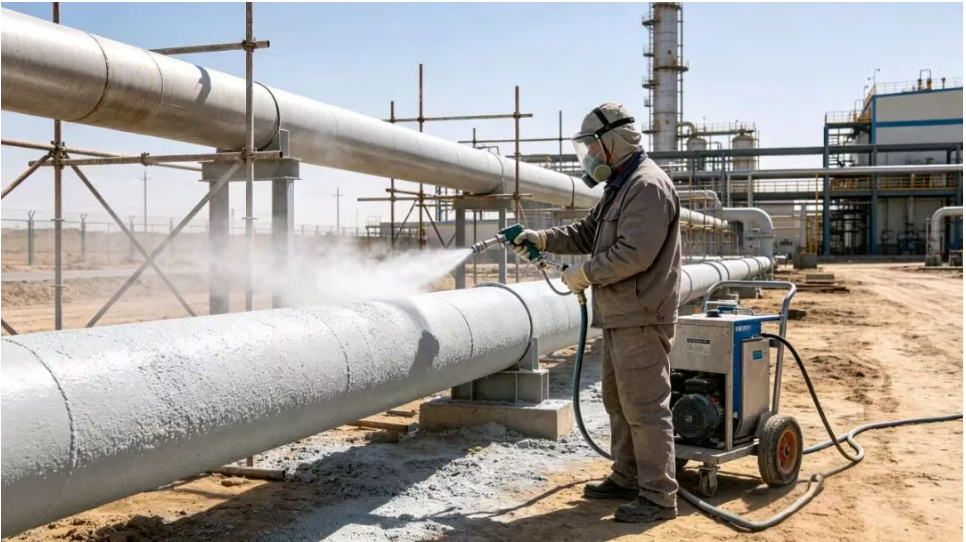
Improve thermal efficiency and maintain stable insulation performance for industrial equipment, tanks, vessels, and exposed process assets.
Industrial insulation applications often operate under demanding conditions, including continuous service, humidity, condensation, temperature cycling, and restricted maintenance access. These conditions are commonly found in storage tanks, pressure vessels, heat exchangers, and process equipment across petrochemical, energy, and manufacturing environments.
Aerogel insulation materials provide a practical solution for these applications, offering low thermal conductivity, hydrophobic performance, and long-term service stability. With thermal conductivity ≤ 0.020 W/m·K, hydrophobic performance above 99.9%, and service capability from -50°C to 650°C, aerogel helps maintain thermal performance in both high-temperature and moisture-prone environments.
In applications involving wet conditions, condensation, or marine exposure, these properties can also support more stable insulation systems and help reduce performance degradation over time.
Need help selecting the right aerogel insulation material?
Send your operating temperature and application details to request technical data, sample support, or quotation information.
Technical data sheets, supporting documents, and project evaluation information are available upon request.
Aerogel insulation materials are widely used in equipment and tank insulation systems where thermal efficiency, moisture resistance, and long-term stability are important selection factors.
| Parameter | Value / Capability |
|---|---|
| Thermal conductivity | ≤ 0.020 W/m·K (@25°C) |
| Hydrophobicity | >99.9% |
| Service temperature | -50°C to 650°C |
| Fire rating | A1 non-combustible |
| Structure | Flexible, lightweight, easy to fit on curved surfaces |
| Installation compatibility | Suitable for standard industrial insulation methods |
| Documentation | TDS, test reports, and supporting documents available |
Aerogel materials used in equipment and tank insulation are most commonly supplied in flexible blanket form, allowing the material’s thermal performance, hydrophobic properties, and installation adaptability to be effectively applied across industrial surfaces.
The blanket structure enables aerogel to conform to flat, curved, and complex geometries, making it suitable for tanks, vessels, separators, heat exchangers, and other process equipment where space constraints and long-term insulation performance are critical.
Supply scope: We supply aerogel insulation materials only. Installation is carried out by your engineering, insulation, or maintenance contractors using standard industrial installation methods.
Continuous operation under varying temperature conditions
Exposure to humidity, condensation, or wet environments
Curved equipment surfaces, nozzles, supports, and structural details
Restricted maintenance access and long service intervals
CUI-sensitive applications requiring reduced moisture intrusion
These conditions increase the importance of stable, moisture-resistant insulation materials with reliable long-term performance.
Lower heat loss through ultra-low thermal conductivity
Moisture resistance that helps maintain insulation performance
Reduced thickness compared with conventional insulation
Flexible installation for complex equipment shapes
Improved long-term stability under harsh conditions
Storage tanks and process tanks
Pressure vessels and separators
Heat exchangers and reactors
Industrial process equipment and exposed hot surfaces
Curved or irregular equipment surfaces with limited installation space
Assets requiring improved thermal retention under humid or marine conditions
CUI-sensitive insulation systems requiring low moisture absorption
Thickness selection depends on operating temperature, surface geometry, energy-saving targets, and installation conditions.
| Thickness | Recommended Application |
|---|---|
| 10 mm | Moderate-temperature equipment and smaller surfaces with lower heat-loss requirements |
| 20 mm | Higher-temperature equipment, exposed surfaces, or applications requiring stronger thermal control |
| Custom | Higher-temperature processes, complex equipment geometry, or project-specific insulation targets |
Guideline: For equipment, tanks, and exposed industrial assets operating under higher temperatures or demanding environmental conditions, 20 mm thickness is commonly selected where stronger heat-loss control and stable long-term performance are required.
→ Contact us for thickness selection guidance based on your operating conditions
Conventional insulation materials may lose performance when exposed to moisture, long service cycles, or repeated temperature fluctuation. In humid or condensation-prone environments, this may increase heat loss, raise maintenance frequency, and reduce service stability.
| Feature | Aerogel | Conventional Insulation |
|---|---|---|
| Thermal conductivity | ≤ 0.020 W/m·K | Typically higher |
| Moisture resistance | >99.9% hydrophobic | More moisture-sensitive |
| Thickness efficiency | Reduced thickness possible | Usually requires greater thickness |
| Curved surface fit | Flexible and conformable | Can be rigid or less adaptable |
| Long-term stability | Stable under demanding service conditions | Performance may decrease over time in wet environments |
| Fire classification | A1 non-combustible | Depends on material type |
Technical Data Sheets typically include:
Thermal conductivity
Hydrophobicity
Service temperature
Fire classification
Mechanical and physical properties
Supporting documents available upon request:
Test reports
Application reference information
Product specifications for evaluation
We are a supplier of aerogel-based insulation materials for equipment, tank, and industrial insulation applications.
Supply high-performance aerogel insulation materials
Support technical evaluation and material selection
Provide product documentation for procurement and review
Compatible with standard industrial installation practices
We do not provide installation services.
Installation is completed by your engineering, insulation, or maintenance contractors according to project requirements.
Yes. Aerogel insulation blankets are suitable for tanks, vessels, and exposed equipment where low thermal conductivity, hydrophobic behavior, and flexible installation are important.
Aerogel insulation is highly hydrophobic, which helps reduce moisture ingress and maintain more stable insulation performance in humid or condensation-prone environments. This is one reason it is considered in CUI-sensitive applications.
Yes. The blanket structure is flexible and can conform to nozzles, vessel heads, separators, supports, and other irregular industrial geometries more easily than rigid insulation materials.
Thickness depends on temperature, insulation target, and installation conditions. In many applications, 10 mm is used for moderate-temperature service, while 20 mm is more commonly selected for higher temperatures or stronger heat-loss control requirements.
Yes. Hydrophobic performance above 99.9% helps limit moisture absorption and supports insulation stability in humid, coastal, and marine operating environments.
Compared with many conventional insulation materials, aerogel can offer lower thermal conductivity (≤ 0.020 W/m·K), reduced thickness, improved fit on complex shapes, and better moisture resistance in demanding service environments.
Request Technical Data or Quotation Support
Send your application details for aerogel material and thickness selection.