Home >> Products >> Aerogel Coating
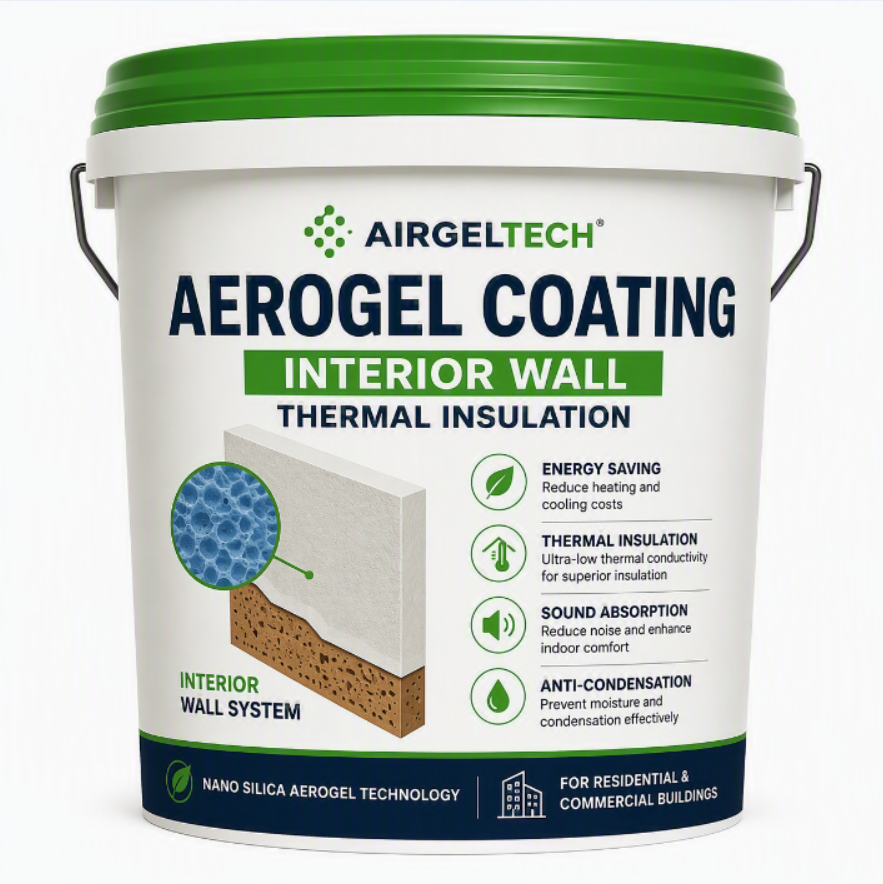
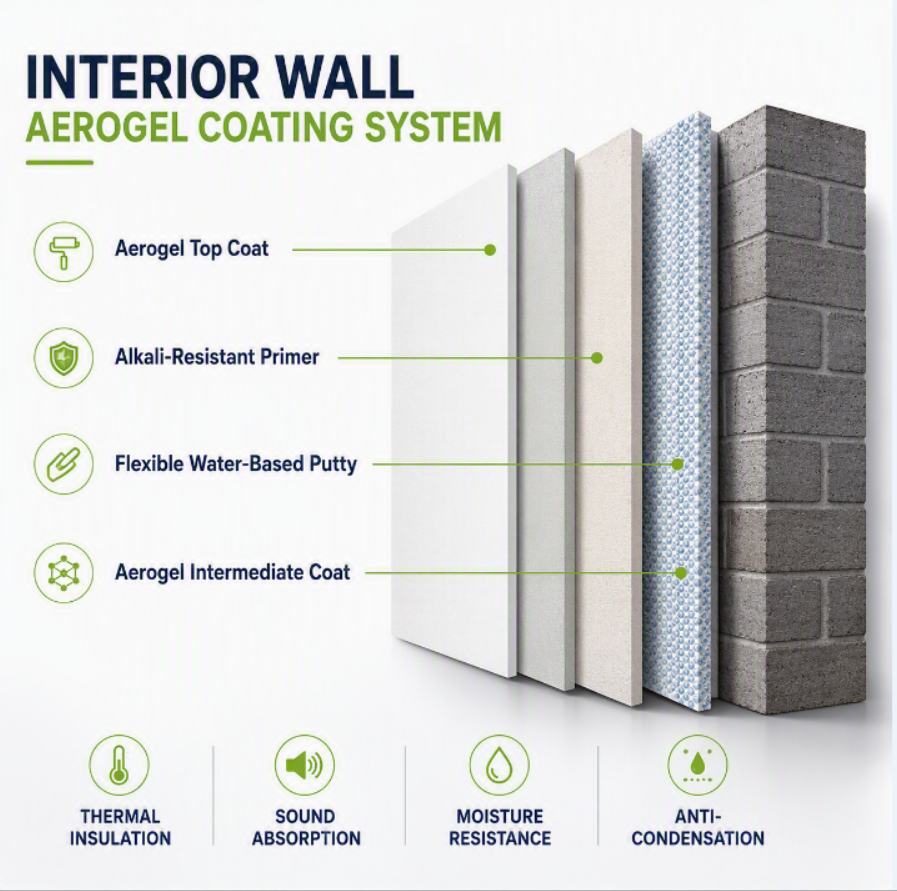
Interior Wall Aerogel Thermal Insulation Coating is a high-performance water-based insulation coating formulated with nano silica aerogel technology. It provides excellent thermal insulation, energy efficiency, fire resistance, and long-term durability for residential, commercial, and public buildings while minimizing coating thickness and maximizing indoor comfort.
High-Performance Water-Based Thermal Insulation Coating for Interior Walls
Interior Wall Aerogel Thermal Insulation Coating is an advanced water-based insulation coating formulated with nano-porous silica aerogel and carefully selected functional fillers. It creates a thin, lightweight thermal barrier that helps reduce heat transfer through interior surfaces while preserving valuable indoor space.
The material is designed to improve indoor thermal comfort throughout the year. By limiting heat loss during colder periods and reducing heat gain during warmer periods, the coating helps maintain more stable indoor temperatures and reduce the demand placed on heating and cooling systems.
In addition to thermal insulation, the coating provides moisture resistance and helps control surface condensation. Its nano-porous structure can also contribute to improved acoustic comfort by absorbing part of the sound energy within an indoor environment.
Unlike conventional insulation systems that require thick boards, framing, or complex installation, Interior Wall Aerogel Thermal Insulation Coating can be applied directly to properly prepared interior substrates. The thin coating system makes it particularly valuable where available space, installation flexibility, surface continuity, and interior aesthetics are important considerations.
Interior insulation projects often involve more than simply reducing heat transfer. Limited space, thermal bridges, cold wall surfaces, condensation, moisture exposure, and irregular substrates can all affect the performance and practicality of a conventional insulation system.
Thick insulation boards may reduce usable indoor space and can be difficult to install around corners, columns, joints, pipes, and other complex details. Discontinuous installation may also leave untreated areas that become potential thermal bridges.
Interior Wall Aerogel Thermal Insulation Coating provides a continuous and lightweight insulation layer that conforms closely to the substrate. This helps improve insulation coverage across flat, curved, detailed, and difficult-to-access surfaces while minimizing the impact on the original dimensions and appearance of the interior space.
Silica aerogel contains an extremely fine porous structure that restricts heat movement through the material. When incorporated into a specially formulated coating system, the aerogel creates an efficient thermal barrier in a significantly thinner layer than many conventional insulation solutions.
The coating adds minimal thickness and weight to the existing wall structure. This helps preserve usable indoor space and reduces the need for bulky supporting systems.
By reducing heat transfer through interior surfaces, the coating helps minimize uncomfortable hot or cold wall conditions and supports a more stable indoor temperature throughout the year.
The coating can form a continuous insulation layer across joints, corners, curved areas, and irregular surfaces. This helps reduce localized heat loss caused by gaps and discontinuities in traditional insulation systems.
The coating helps increase the temperature of treated interior surfaces, reducing the conditions that can lead to surface condensation. This supports better moisture management and a more comfortable indoor environment.
Reduced heat transfer can lower the heating and cooling demand of a building. This contributes to improved energy efficiency and may help reduce operating costs, depending on the building design, climate, coating thickness, and overall insulation system.
The nano-porous structure can contribute to sound absorption and help improve the acoustic quality of indoor spaces. The coating is intended to support acoustic comfort rather than replace a dedicated soundproofing system.
The water-based formulation is designed for convenient indoor use, with low odor and reduced environmental impact compared with many solvent-based coating systems.
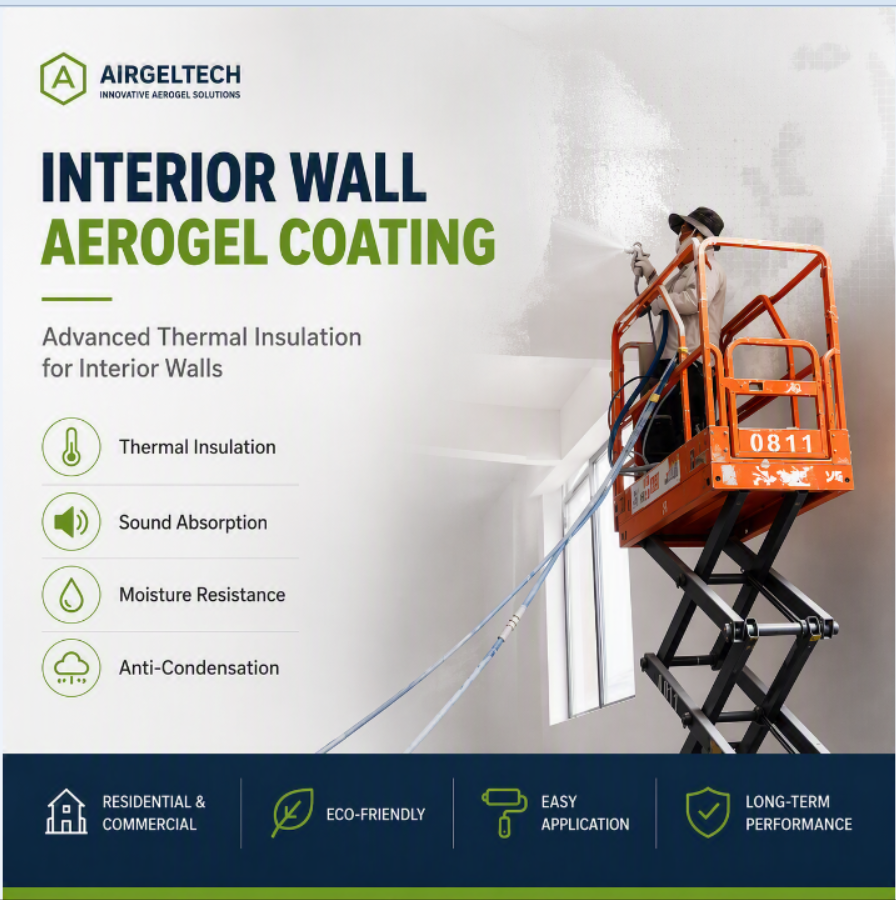
The coating can be applied by spraying or troweling, depending on the required thickness, substrate condition, surface finish, and project requirements.
With appropriate substrate preparation, application, and protection, the coating provides a durable thermal insulation layer designed to maintain stable performance over its service life.
The nano-porous aerogel structure restricts heat movement through the coating layer. This creates an additional thermal barrier between the interior environment and the underlying wall or ceiling surface.
During colder periods, the coating helps reduce heat loss through treated surfaces. Warmer interior surface temperatures can improve comfort and reduce the demand placed on heating systems.
During warmer periods, the thermal barrier helps limit heat entering the indoor environment through walls and ceilings. This can support cooler, more comfortable indoor conditions.
Reducing heat transfer and surface temperature differences helps create a more balanced indoor climate. Occupants experience fewer uncomfortable hot or cold surfaces and less noticeable temperature fluctuation.
Cold interior surfaces can cause airborne moisture to condense when the surface temperature falls below the dew point. By improving the thermal performance of the treated surface, the coating helps reduce the risk of surface condensation.
The thin coating system minimizes the loss of usable floor area associated with thick internal insulation boards. This is particularly important where interior dimensions and available space must be preserved.
Reducing heat loss and heat gain can decrease the energy required for heating and cooling. The coating can therefore form part of a broader building energy-efficiency strategy.
Unlike rigid insulation boards, the coating can follow corners, curves, joints, columns, and other irregular details. This improves installation flexibility and helps provide more continuous surface coverage.
The coating can be integrated into suitable interior wall systems without constructing a bulky secondary wall. This can simplify insulation upgrades and reduce disruption to the original interior layout.
After the insulation layer has fully dried and the surface has been properly prepared, a compatible finishing system can be applied according to the required decorative effect.
Traditional interior insulation systems commonly use rigid boards, mineral wool, foam materials, framing, mechanical fasteners, or additional finishing layers. While these materials remain suitable for many projects, installation may require considerable thickness and can reduce usable indoor space.
Interior Wall Aerogel Thermal Insulation Coating provides a different approach. The coating combines thermal insulation with the flexibility of a directly applied surface material, making it possible to improve thermal performance without constructing a thick or complicated insulation assembly.
Key advantages include:
The coating is not intended to replace every type of conventional insulation material. Instead, it offers an effective alternative where limited space, complex geometry, surface continuity, installation flexibility, or interior appearance makes a traditional insulation system less practical.
Heat is transferred through conduction, convection, and radiation. An effective insulation material must restrict these heat-transfer mechanisms as much as possible.
Silica aerogel has a three-dimensional nano-porous structure containing an extremely high proportion of microscopic air-filled pores. These pores are sufficiently small to restrict the movement of air molecules and reduce solid-phase heat conduction through the material.
When silica aerogel is dispersed within a compatible coating system, the resulting layer creates a lightweight thermal barrier across the treated surface. The coating combines the insulating properties of aerogel with the adhesion, flexibility, and application advantages of a functional building coating.
This technology allows improved thermal performance with substantially less thickness than many bulky insulation assemblies, making aerogel coating particularly suitable for projects where space efficiency and installation flexibility are priorities.
The key difference between aerogel coating and conventional decorative coating lies in the internal structure of the insulating material.
Ordinary decorative coatings are primarily designed to provide color, surface protection, or a specific finish. They normally offer limited resistance to heat transfer. Aerogel insulation coating contains nano-porous silica aerogel specifically selected to improve the thermal performance of the coating layer.
Compared with rigid boards and fibrous insulation materials, an aerogel coating can conform more closely to the shape of the substrate. This makes it easier to create a continuous thermal barrier over joints, edges, corners, curves, and other complex areas.
The principal differences include:
These characteristics make aerogel coating a practical complement to conventional building insulation systems and a valuable solution for challenging interior insulation requirements.
The actual performance of an interior insulation project depends on more than the coating alone. Substrate condition, coating thickness, surface preparation, application quality, wall construction, climate, humidity, ventilation, and the presence of thermal bridges can all affect the final result.
For reliable performance, the coating should be selected and applied as part of a properly designed wall system. The condition of the substrate should be evaluated before installation, and moisture sources or structural defects should be addressed before the coating is applied.
Airgeltech can provide product selection guidance, technical data, application recommendations, and system support according to the specific conditions of each project.
Airgeltech specializes in advanced aerogel insulation materials and functional coating technologies. Our experience with silica aerogel enables us to develop practical insulation solutions that combine thermal performance, lightweight construction, and application flexibility.
We understand that different projects may involve different substrates, climate conditions, surface finishes, insulation targets, and installation methods. Airgeltech works closely with customers to evaluate these requirements and recommend suitable product and system solutions.
Our product development focuses on the practical application of nano-porous silica aerogel in thermal insulation systems.
Raw material selection, formulation control, manufacturing procedures, and finished-product inspection are managed to ensure consistent product performance.
Technical guidance is available for product selection, substrate preparation, coating application, system compatibility, and project-specific requirements.
We evaluate each project according to the substrate, environmental conditions, required performance, application method, and finishing requirements.
Airgeltech supports different packaging, supply, OEM, and private-label requirements for international distributors and project customers.
Our team supports global customers with technical documentation, quotations, sample arrangements, export packaging, logistics coordination, and after-sales communication.
Airgeltech Interior Wall Aerogel Thermal Insulation Coating combines nano-porous silica aerogel technology with a practical water-based coating system. It provides a thin, lightweight, and adaptable thermal barrier that helps reduce heat transfer, improve indoor comfort, control condensation, preserve interior space, and support building energy-efficiency objectives.
For projects where traditional insulation is too thick, difficult to install, or unsuitable for complex interior surfaces, Airgeltech provides a flexible aerogel coating solution supported by professional technical expertise and reliable international service.