
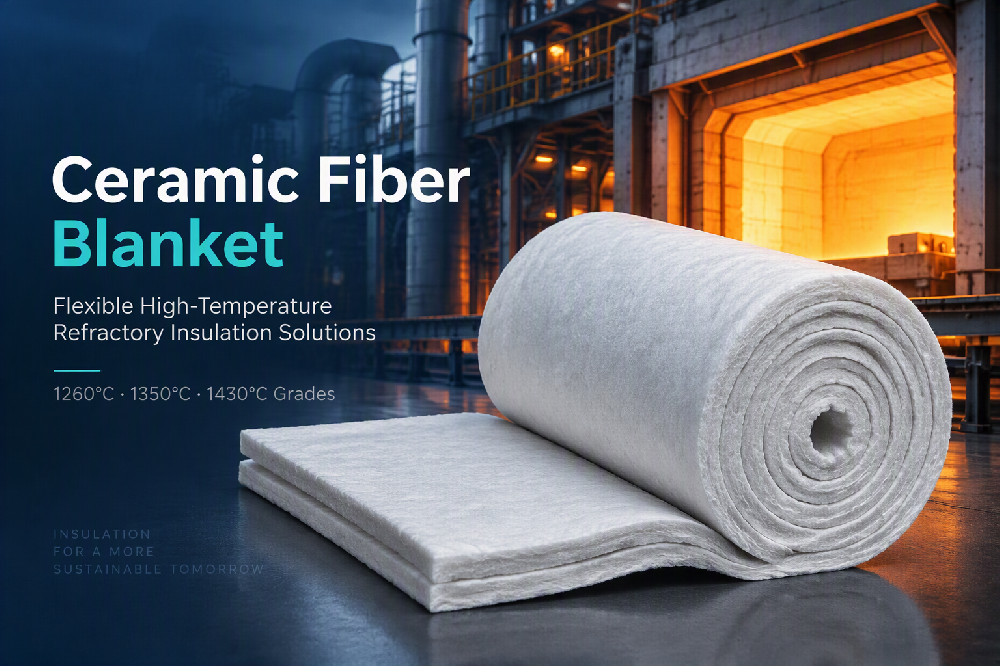
Looking for a reliable high-temperature insulation material for furnaces, kilns, petrochemical equipment, industrial piping, and thermal processing systems?
Airgeltech Ceramic Fiber Blanket is a lightweight, flexible refractory insulation material manufactured from alumina-silica ceramic fibers through a mechanical needling process.
Designed for demanding thermal environments, ceramic fiber blanket combines low thermal conductivity, low heat storage, thermal shock resistance, and installation flexibility. It is widely used in industrial furnaces, process heaters, kilns, petrochemical facilities, power generation systems, and high-temperature piping applications.
Available in multiple temperature classifications and densities, Airgeltech ceramic fiber blanket solutions help support reliable thermal performance in elevated-temperature operating environments.
Ceramic fiber blanket is produced from high-temperature alumina-silica fibers that are mechanically entangled through a needling process to form a resilient insulation blanket.
Unlike rigid refractory materials, ceramic fiber blanket offers:
The long-fiber blanket structure allows installation around pipes, expansion joints, furnace walls, equipment surfaces, and irregular thermal systems.
Available ceramic fiber blanket classifications include 1260°C, 1350°C, and 1430°C for different furnace, kiln, process-heater, and refractory insulation requirements.
The porous fiber structure helps reduce conductive heat transfer and contributes to improved energy efficiency. Compared with dense refractory products, ceramic fiber blanket stores significantly less heat, helping improve heating and cooling efficiency.
Its flexible structure performs well under repeated thermal cycling conditions. The needled-fiber construction provides strength and mechanical integrity during handling and installation.
Ceramic fiber blanket can be:
Ceramic fiber blanket provides stable thermal performance across many industrial operating environments. Suitability should always be evaluated for applications involving aggressive chemicals, molten materials, or specialized atmospheres.
| Product Grade | Classification Temperature | Typical Application |
|---|---|---|
| Standard Ceramic Fiber Blanket | 1260°C | General industrial thermal insulation |
| High Purity Ceramic Fiber Blanket | 1260°C | Improved purity and thermal stability requirements |
| High Alumina Ceramic Fiber Blanket | 1350°C | Higher-temperature industrial equipment |
| Zirconia Ceramic Fiber Blanket | 1430°C | Demanding high-temperature thermal systems |
Important Notice: Classification temperature is a standardized product-rating reference and should not automatically be interpreted as the recommended continuous operating temperature.
| Property | Available Options |
|---|---|
| Classification Temperature | 1260°C / 1350°C / 1430°C |
| Density | 64 / 96 / 128 kg/m³ |
| Material Type | Alumina-Silica Fiber |
| Product Form | Flexible Needled Blanket |
| Supply Format | Roll Blanket |
| Custom Cutting | Available Upon Request |
Available dimensions, thicknesses, widths, and roll lengths vary according to product grade and project requirements.
Both materials are widely used in thermal insulation applications, but they address different engineering priorities.
| Comparison Item | Ceramic Fiber Blanket | Aerogel Blanket |
|---|---|---|
| Primary Application | Refractory and high-temperature systems | High-performance industrial insulation |
| Thermal Conductivity | Low | Typically lower |
| Required Thickness | Generally higher | Generally lower |
| Space Saving | Moderate | Excellent |
| Flexibility | Excellent | Excellent |
| Temperature Capability | Excellent | Excellent |
| Initial Material Cost | Generally lower | Generally higher |
Ceramic fiber blanket is commonly selected for high-temperature refractory systems, while aerogel blanket is often preferred where low thermal conductivity and reduced insulation thickness are critical requirements.
Select the appropriate product grade based on actual operating conditions. Classification temperature should not automatically be treated as recommended continuous-use temperature.
Typical available densities include 64 kg/m³, 96 kg/m³, and 128 kg/m³. Higher densities generally provide improved mechanical stability.
Required thickness should be determined according to: heat-loss calculations, surface temperature targets, energy-efficiency requirements, and available installation space.
Consider furnace atmosphere, chemical exposure, gas velocity, thermal cycling, and mechanical loading when selecting insulation materials.
What is ceramic fiber blanket?
Ceramic fiber blanket is a flexible refractory insulation material manufactured from needled alumina-silica ceramic fibers for high-temperature thermal insulation applications.
What temperature grades are available?
Airgeltech ceramic fiber blanket products are available in 1260°C, 1350°C, and 1430°C classification grades.
Is classification temperature the same as working temperature?
No. Classification temperature is a standardized product rating and should not automatically be interpreted as the recommended continuous operating temperature.
What density ceramic fiber blanket should I choose?
Typical densities include 64, 96, and 128 kg/m³. Selection depends on application requirements and insulation design considerations.
What thickness ceramic fiber blanket is recommended?
Required thickness should be determined through engineering calculations based on operating temperature, heat-loss targets, and installation constraints.
What is the difference between 1260°C and 1430°C ceramic fiber blanket?
1430°C grades typically contain zirconia and are designed for higher-temperature thermal systems. 1260°C grades are widely used in general industrial insulation applications.
Can ceramic fiber blanket be used for pipe insulation?
Yes. Ceramic fiber blanket is widely used in high-temperature industrial piping systems and thermal process equipment.
Is ceramic fiber blanket the same as ceramic wool?
Ceramic wool is a commonly used market term. Ceramic fiber blanket is the more precise product description for flexible needled ceramic-fiber insulation blankets.
Is ceramic fiber blanket better than aerogel blanket?
Each material serves different engineering objectives. Ceramic fiber blanket is commonly selected for refractory and elevated-temperature applications, while aerogel blanket is typically selected where thinner insulation systems and lower thermal conductivity are desired.
Provide the following information to help our engineering team recommend the most suitable solution:
The Airgeltech technical team can recommend a suitable ceramic fiber blanket grade and provide technical data for project evaluation.
Get In Touch With Us
