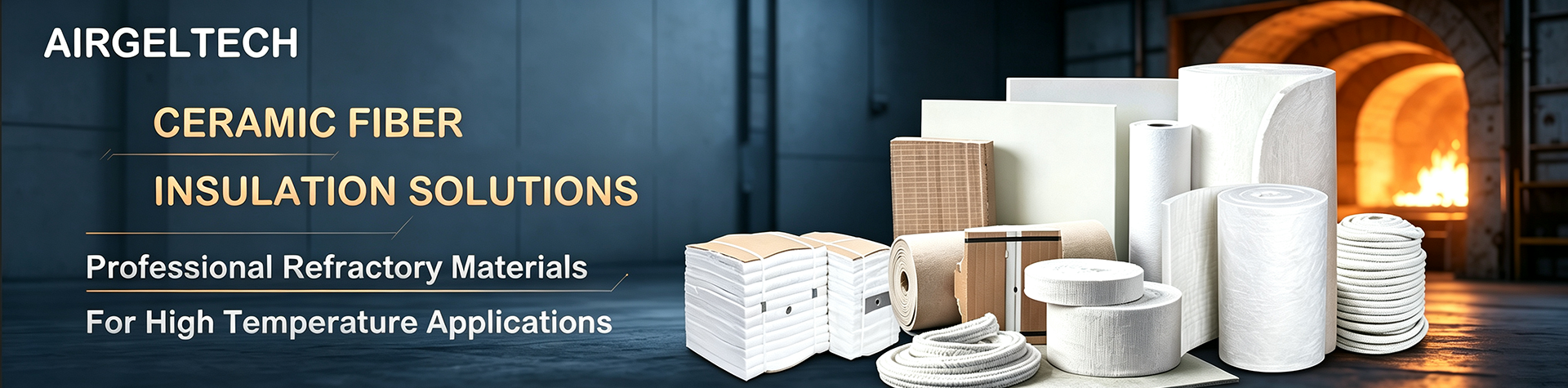
Explore ceramic fiber insulation products for furnaces, kilns, boilers, piping and thermal equipment, including blankets, boards, papers, modules, bulk fibers and textiles.
High-Temperature Insulation for Industrial Applications
Airgeltech offers ceramic fiber blankets, boards, papers, modules, bulk fibers, and textiles for furnaces, kilns, boilers, pipes, ducts, thermal barriers, and high-temperature sealing applications.
Choose the product form that best matches your application, equipment design, available space, and installation requirements.
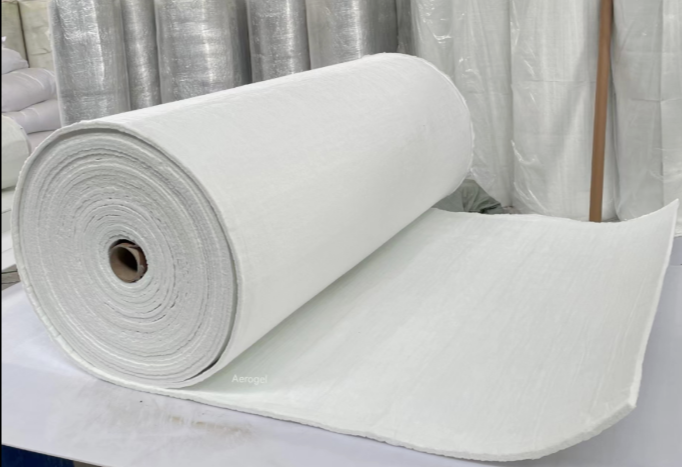
Flexible roll insulation for wrapping and lining.
For furnaces, kilns, boilers, pipes, ducts, and curved or irregular surfaces.
View Ceramic Fiber Blanket →Rigid insulation where dimensional stability matters.
For furnace walls, kiln linings, heat shields, equipment panels, and backup insulation.
View Ceramic Fiber Board →Thin thermal insulation for restricted spaces.
For thermal barriers, gaskets, separators, heat shields, and space-limited components.
View Ceramic Fiber Paper →Modular insulation for furnace and kiln linings.
Prefabricated components for structured high-temperature lining systems.
View Ceramic Fiber Module →Loose fiber for filling, forming, and processing.
For loose-fill insulation, packing, and production of formed ceramic fiber products.
View Ceramic Fiber Bulk →High-temperature sealing and wrapping products.
Rope, tape, and cloth for furnace doors, pipes, expansion joints, and equipment connections.
View Ceramic Fiber Textile →Start with the required material form and installation method.
| Your Requirement | Recommended Product | Explore |
|---|---|---|
| Flexible wrapping or layered insulation | Ceramic Fiber Blanket | View Blanket → |
| Rigid, self-supporting insulation | Ceramic Fiber Board | View Board → |
| Thin insulation or thermal separation | Ceramic Fiber Paper | View Paper → |
| Furnace or kiln lining system | Ceramic Fiber Module | View Module → |
| Loose filling or further processing | Ceramic Fiber Bulk | View Bulk → |
| High-temperature sealing or wrapping | Ceramic Fiber Textile | View Textile → |
Product form is only the first step. Final selection should also consider operating temperature, equipment design, available insulation space, installation conditions, and the technical data of the selected grade.
Not sure which product fits your application? Get a Product Recommendation →
Blankets, boards, and modules for furnace and kiln walls, roofs, doors, backup linings, and expansion areas.
Lightweight high-temperature insulation around hot surfaces, access doors, ducts, and thermal equipment.
Flexible blanket for wrapping pipes, ducts, valves, bends, and irregular surfaces where rigid insulation is difficult.
Blankets, boards, and modules for ovens, heat treatment furnaces, thermal chambers, and cyclic heating equipment.
Boards and papers for rigid or thin thermal separation between hot components and surrounding equipment.
Paper and textile products for high-temperature sealing, furnace doors, equipment connections, and expansion areas.
Ceramic fiber is lightweight and low-thermal-mass, helping reduce heat loss, heat storage, and lining weight while adapting to different equipment designs.
Low thermal conductivity limits heat transfer through linings, surfaces, pipes, and ducts.
Less energy absorbed during heating supports faster response in cyclic equipment.
Lower-weight lining solutions than many dense refractories, simplifying handling and structural load.
Flexible, rigid, thin-sheet, modular, loose-fiber, and textile forms for different equipment geometry.
Actual thermal performance depends on the selected material, operating temperature, density, thickness, and installation conditions.
For initial product selection, consider four factors.
Identify the normal operating temperature, maximum exposure temperature, process atmosphere, and thermal cycling conditions.
Classification temperature should not automatically be treated as recommended continuous operating temperature.
Final grade selection should be checked against the technical data of the selected product and the actual service conditions.
Select the product form according to equipment geometry, required flexibility or rigidity, available installation space, and installation method.
Use the product selection guide above to identify the most suitable starting point.
Consider available insulation space and required thermal result, such as reducing heat loss or achieving a target external surface temperature.
Where a specific thickness is required, base selection on the relevant thermal data and actual operating conditions.
Consider available space, equipment geometry, fastening method, mechanical exposure, joints, thermal movement, installation access, and maintenance requirements.
Compare available temperature grades, densities, thicknesses, thermal conductivity, and other technical properties on each product page.
Ceramic fiber blanket is flexible and suited to wrapping, layering, pipes, ducts, curved surfaces, and irregular equipment.
Ceramic fiber board is rigid and better suited to applications requiring dimensional stability or a self-supporting insulation layer.
Paper is typically selected when a thin, uniform thermal barrier is required, particularly for gaskets, separators, heat shields, and space-limited applications.
Blanket is generally better suited to thicker flexible insulation, wrapping, and layered lining applications.
Blankets, boards, and modules can all form part of a furnace insulation system, but they serve different functions.
Blanket provides flexible insulation, board provides rigid insulation, and modules are designed for structured furnace and kiln lining systems.
The appropriate combination depends on operating temperature, lining design, process atmosphere, thermal cycling, and installation requirements.
Start with the normal operating temperature and maximum exposure temperature, then consider the process atmosphere, thermal cycling, mechanical conditions, installation design, and selected product form.
A product's classification temperature should not automatically be treated as its recommended continuous operating temperature.
Final selection should be confirmed against the technical data for the specific grade and actual service conditions.
You do not need to determine every technical parameter before contacting us.
If the application is known but the product or specification is not, provide:
Application or equipment
Normal operating temperature
Maximum exposure temperature
Target external surface temperature, if available
Available insulation space
Equipment dimensions
Approximate quantity
Destination country
Airgeltech can review the application and help identify a suitable product family and preliminary specification.
Get a Product Recommendation →If the required product is already defined, provide:
Product type
Temperature grade
Density and thickness
Dimensions
Quantity
Packaging requirements, if applicable
Destination country or delivery location
Our team can review the specification and prepare the relevant product information and quotation.
Request a Quote →